
The Evolution of Market Data Infrastructure
For decades, capital markets and institutional financial platforms have operated on bifurcated architecture. High-frequency real-time tick data flows through fragile, custom C++ UDP/TCP multicast pipelines, while historical analytics rely on massive, batch-loaded relational or time-series databases. This structural split forces systems to maintain separate logic for streaming and historical data, making it difficult to keep context aligned across both views.
As corporate actions reassign tickers, legal entities restructure, and global exchanges alter identifier standards, traditional architectures struggle to maintain semantic consistency. A quantitative model or algorithmic execution engine querying tick data from five years ago often processes data under present-day symbology, leading to silent failures, inaccurate backtests, and broken mapping logic.
The rapid adoption of Generative AI and Autonomous Agents has intensified these challenges:
- Context Vacuum: Large Language Models (LLMs) and autonomous agents cannot infer missing domain relationships from raw, unstructured tick streams.
- Brittle Data Pipelines: Custom ETL scripts break when venue symbologies drift or vendor schemas change.
- Latent Access: Querying massive historical lakehouses using SQL over object storage introduces unacceptable latency for real-time decision loops.
To address these challenges, viaNexus introduces a unified Streamhouse an AI DataLakehouse architecture. Operating as an event-driven, language-agnostic platform, viaNexus connects real-time streaming feeds with historical time-series analytics, delivering structured, context-rich, and AI-ready data products.
Unified Ingestion & High-Performance Event Pipeline
The foundation of viaNexus is its ability to ingest high-volume financial data from diverse sources without forcing downstream services to adapt to disparate protocols or schemas.
Streamhouse Architecture: Star/Planetary Model
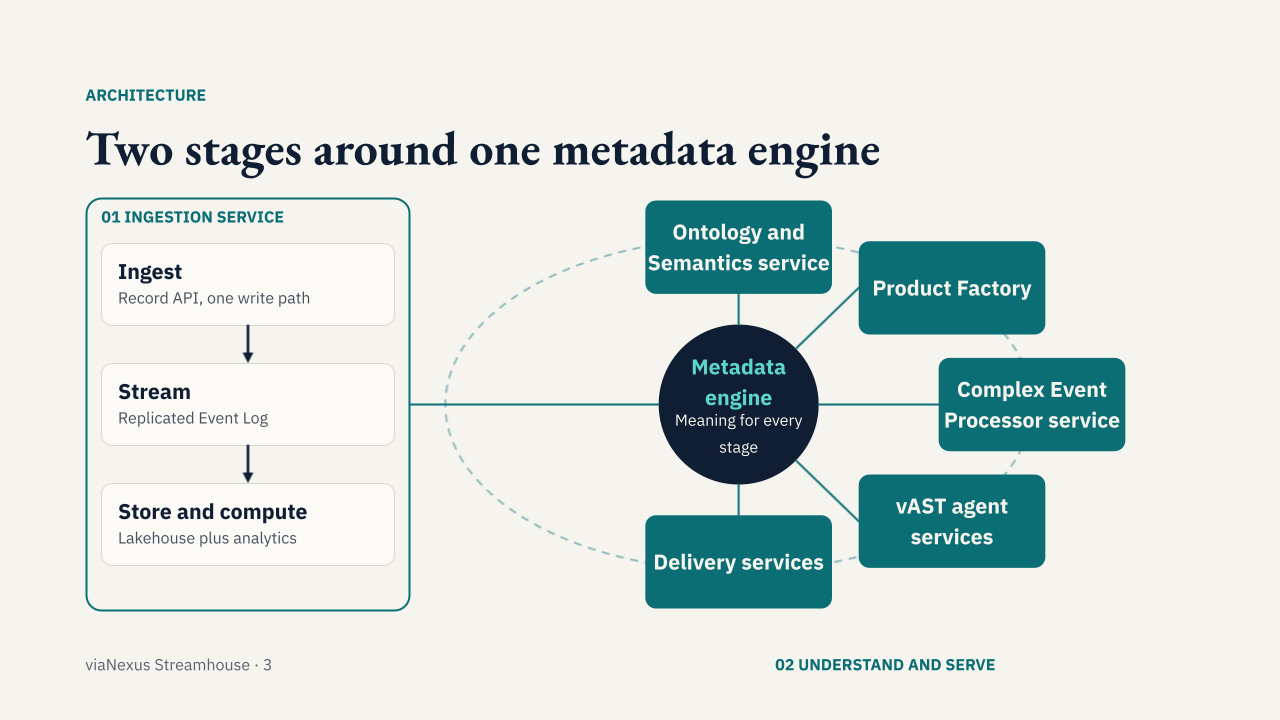
The viaNexus Streamhouse architecture employs a Star/Planetary model designed for extreme modularity, business flexibility, and enterprise-grade platform scalability. In this system, specialized services revolve around a central Metadata Engine, which acts as the core (or "sun") providing semantic context and unified meaning across every processing stage. As an enterprise grows, this decoupled topology allows organization leaders to scale operational throughput and onboard new market data vendors or internal streams independently—eliminating platform-wide rearchitecting or service downtime.
By isolating domain concerns across planetary satellite services, the architecture delivers the business agility needed to rapidly adapt to evolving market requirements, changing regulatory standards, and expanding product portfolios alongside raw technical performance:
- 01 Ingestion Service: Handles data lifecycle entry through unified ingestion via the Record API, streaming through the Replicated Event Log, and persistent storage in the Lakehouse alongside high-performance compute analytics.
- 02 Understand and Serve: Encompasses planetary satellite services orbiting the Metadata Engine, including Ontology and Semantics, the Product Factory, Complex Event Processors (CEP), vAST Agent Services, and multi-channel Delivery Services.
- 03 Business Agility & Scalability: Satellite services can be added, upgraded, or reconfigured independently without disturbing central metadata logic or active ingestion pipelines. This modular framework allows enterprises to launch specialized analytics, integrate custom AI agents, and seamlessly expand into new asset classes or regions as business demand scales.
Unified Front Door: The Record API
Every data payload—whether ultra-low-latency exchange ticks (ITCH/OUCH, FIX, binary UDP), nightly batch files (CSV, Parquet), or external webhooks—enters viaNexus through a standardized write path called the Record API.
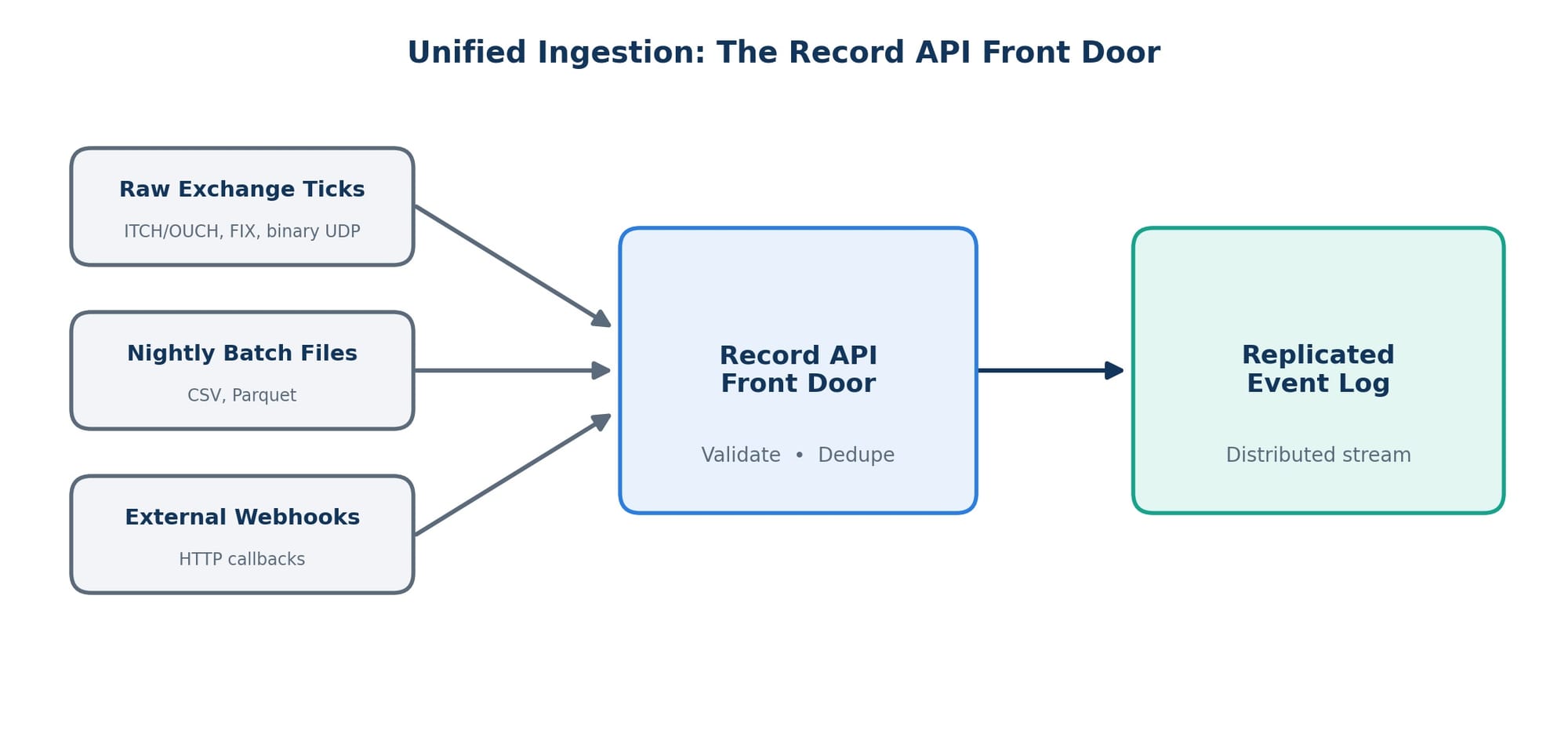
The Record API acts as an inline processing gateway, executing key tasks prior to storage:
- Real-Time Data Profiling & Automated Productization: The Record API continuously inspects incoming record streams to discover newly posted data structures in real time. Upon identifying novel parameters, formats, or endpoints, the platform dynamically infers the target schema, provisions a corresponding dataset product, and generates full API documentation and metadata without requiring manual engineering intervention or pipeline reconfiguration.
- Schema Validation & Normalization: Validates incoming payloads against predefined protocol schemas (Avro/Protobuf) to prevent malformed records from reaching downstream consumers.
- Data Quality & Deduplication: Checks timestamps and sequence numbers in real time, dropping duplicates and tagging out-of-order records.
- Entitlement & Metering: Inspects cryptographic tokens to verify producer permissions and record ingestion metrics for billing and compliance audit trails.
The Replicated Event Log
Once validated, records are committed to a durable, multi-tenant Replicated Event Log built on a distributed append-only architecture. Partitioned by domain and asset class, this log decouples data ingestion from storage consumers:
- Real-Time Streaming Consumers: Low-latency trading engines, alert systems, and websocket gateways tail the event log directly from memory buffers.
- Historical Commit Engines: Async workers read from the log, batch events into columnar formats, and write them to persistent storage.
- Analytics Engines: Real-time stream processors compute rolling metrics without adding query latency for active consumers.
Decoupled Lakehouse Storage
For long-term storage and analytical queries, viaNexus decouples compute from storage. Data is saved in open table formats (such as Apache Iceberg) on high-throughput object storage. This enables:
- Query-in-Place Analytics: Querying historical time-series data using engines like StarRocks DB or custom query engines without manual re-indexing.
- Schema Evolution: Supporting schema modifications—such as adding exchange fields or regulatory tags—without rewriting historical datasets.
The Semantic Layer: Knowledge Graph & Ontology Engineering
A primary bottleneck in financial data processing is resolving entity relationships and historical symbology. Raw market data provides ticker symbols, but traders and AI models operate on broader business concepts—such as legal entities, corporate hierarchies, and geographic risk exposure.
Ontology Framework
viaNexus establishes a formal ontology for financial instruments, regulatory frameworks, and market participants. Core entities in this semantic graph include:
- Securities: Common Stock, Preferred Shares, Corporate Bonds, Options, Futures, Swaps.
- Organizations: Issuers, Ultimate Parent Companies, Market Identifier Codes (MIC), Legal Entity Identifiers (LEI).
- Asset Classes & Instrument Types: Fixed Income, Foreign Exchange, Commodities, Equities, Derivatives.
- Contextual Datasets: Macroeconomic indicators, ESG scores, earnings transcripts, regulatory filings.
Temporally Embedded Knowledge Graph
To manage entity relationships over time, viaNexus uses a graph database engine (such as FalkorDB/RedisGraph). Vertices represent domain entities, while edges store temporal validity intervals [t_start, t_end].
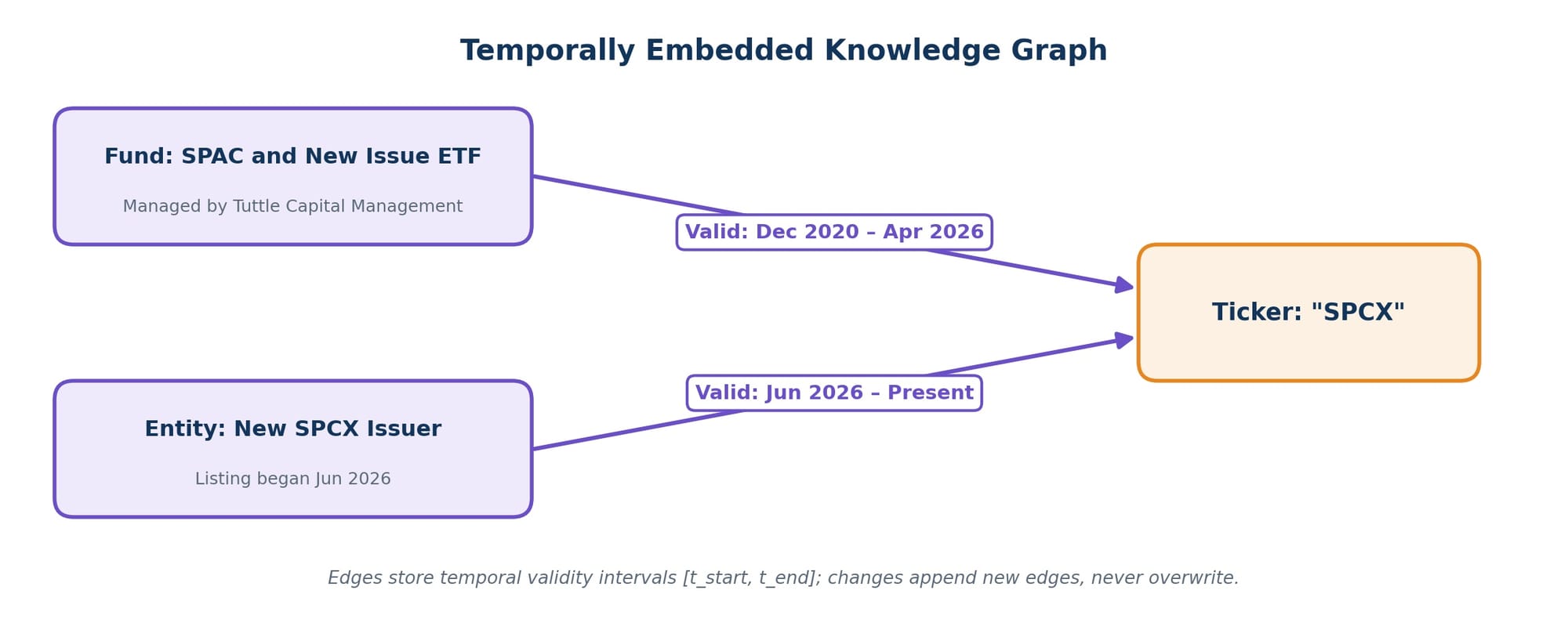
Edges record active validity windows for each relationship. When a corporate acquisition, spinoff, or ticker change occurs, the graph appends a new edge with updated timestamps rather than overwriting existing records.
Solving Temporal Symbology Clashes
A common issue in financial datasets is ticker symbol recycling. For instance, the ticker SPCX might refer to an acquisition corp from 2012 to 2018, and later be reassigned to a different ETF in 2020. Naive database lookups often collapse these distinct entities into a single time-series, distorting historical analysis.
viaNexus resolves these clashes directly on the read path:
- Mapping Local Identifiers: External IDs (ISIN, CUSIP, FIGI, RIC, local venue tickers) map directly to a permanent internal identifier: the BlueSkyNexus ID (BSN-ID).
- Point-in-Time Resolution: When querying data for a given timestamp T, the system evaluates the graph at T to resolve the exact BSN-ID associated with the symbol at that time.
Conceptual Search over String Lookups
By embedding this ontology into the read path, viaNexus enables intent-based conceptual queries. Rather than searching for exact strings across disparate tables, users and agents can execute semantic queries such as:"Retrieve the top bid-ask spread variance for all Tier 2 subordinated debt instruments issued by European G-SIBs subject to MiFID II reporting during market volatility events in Q3."
The Knowledge Graph traverses these underlying relationships, identifies matching BSN-IDs, and pulls the relevant time-series data from the lakehouse instantly.
Real-Time Productization & The "Product Factory" Loop
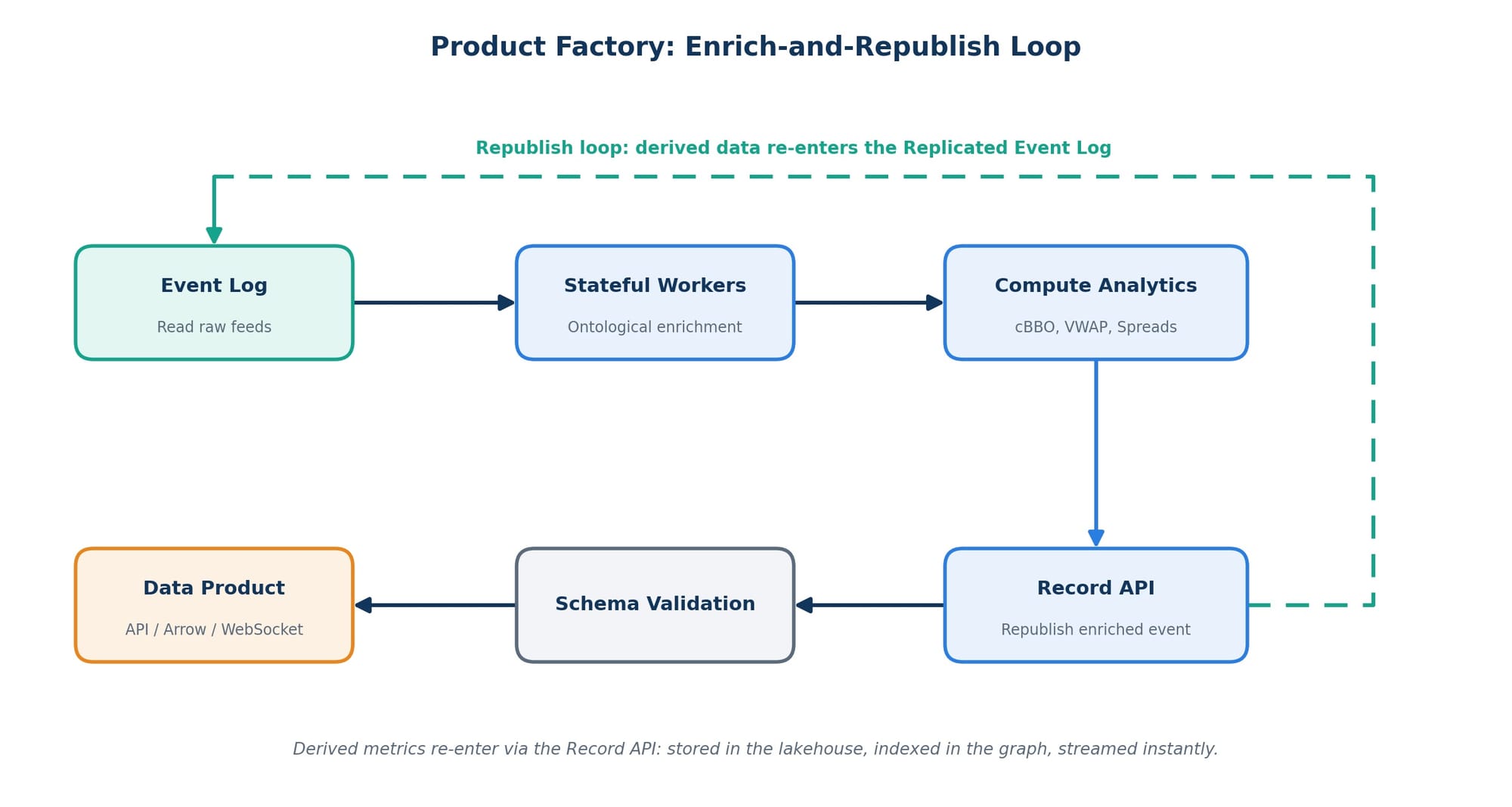
Raw data feeds often require substantial cleanup before downstream applications can consume them. The viaNexus Product Factory addresses this by converting raw event streams into derived, semantically enriched data products in real time.
Enrich-and-Republish Architecture
- Stream Consumption: Stateful stream-processing engines read raw execution and quote streams from the Replicated Event Log.
- Ontological Enrichment: Incoming ticks are decorated in-memory with graph metadata from the semantic layer (such as asset class, LEI, sector, and risk ratings).
- Derived Analytics Computation: Stream workers compute real-time windowed metrics, including:
- Implied Predicted Pricing: Running predictive algorithms and ML-driven pricing models over high-frequency tick data streams in real-time to forecast short-term price movements and asset valuations in real time.
- cBBO (Consolidated Best Bid and Offer): Consolidating quotes across fragmented venues to track national best bid/offer prices.
- Volume-Weighted Average Price (VWAP): Calculating continuous rolling intraday VWAP metrics.
- Spread & Volatility Metrics: Tracking rolling bid-ask spreads, order book imbalance, and historical volatility.
- Republishing Loop: Computed metrics are packaged into self-describing payloads and republished directly back through the Record API.
AI-Ready Dataset Products
By routing derived analytics back through the ingestion pipeline, generated metrics are stored in the Lakehouse, indexed in the Knowledge Graph, and made immediately available via streaming APIs. Downstream systems can consume these normalized metrics as self-describing data products through platform provided interfaces for streaming such websockets and historical batch through Web/Restful ultra fast APIs
Built for the AI Era: viaNexus Agentic Services Technology (vAST)
Traditional market data infrastructures rely on polling-based REST APIs or raw text feeds, which introduce latency and processing bottlenecks when integrated with LLMs and AI agents. The viaNexus Agentic Services Technology (vAST) layer provides a native framework designed specifically for autonomous agent integration.
Addressing AI Hallucinations & Token Consumption
Asking an LLM to calculate continuous volume-weighted averages or compute real-time order-book imbalances from raw tick feeds introduces operational challenges:
- Precision Errors: LLMs are prone to arithmetic errors when performing floating-point financial calculations in-context.
- High Token Consumption: Ingesting thousands of raw price ticks consumes substantial token capacity, driving up costs and expanding context window sizes.
vAST addresses this by supplying pre-calculated, verified metrics through the semantic layer. Instead of processing raw market feeds, the agent requests pre-computed analytical products directly, reducing token consumption while preserving deterministic accuracy.
Native Model Context Protocol (MCP) & Agent Entitlements
vAST natively supports the Model Context Protocol (MCP), allowing AI agents to interact with viaNexus tools and data resources using standardized interfaces.
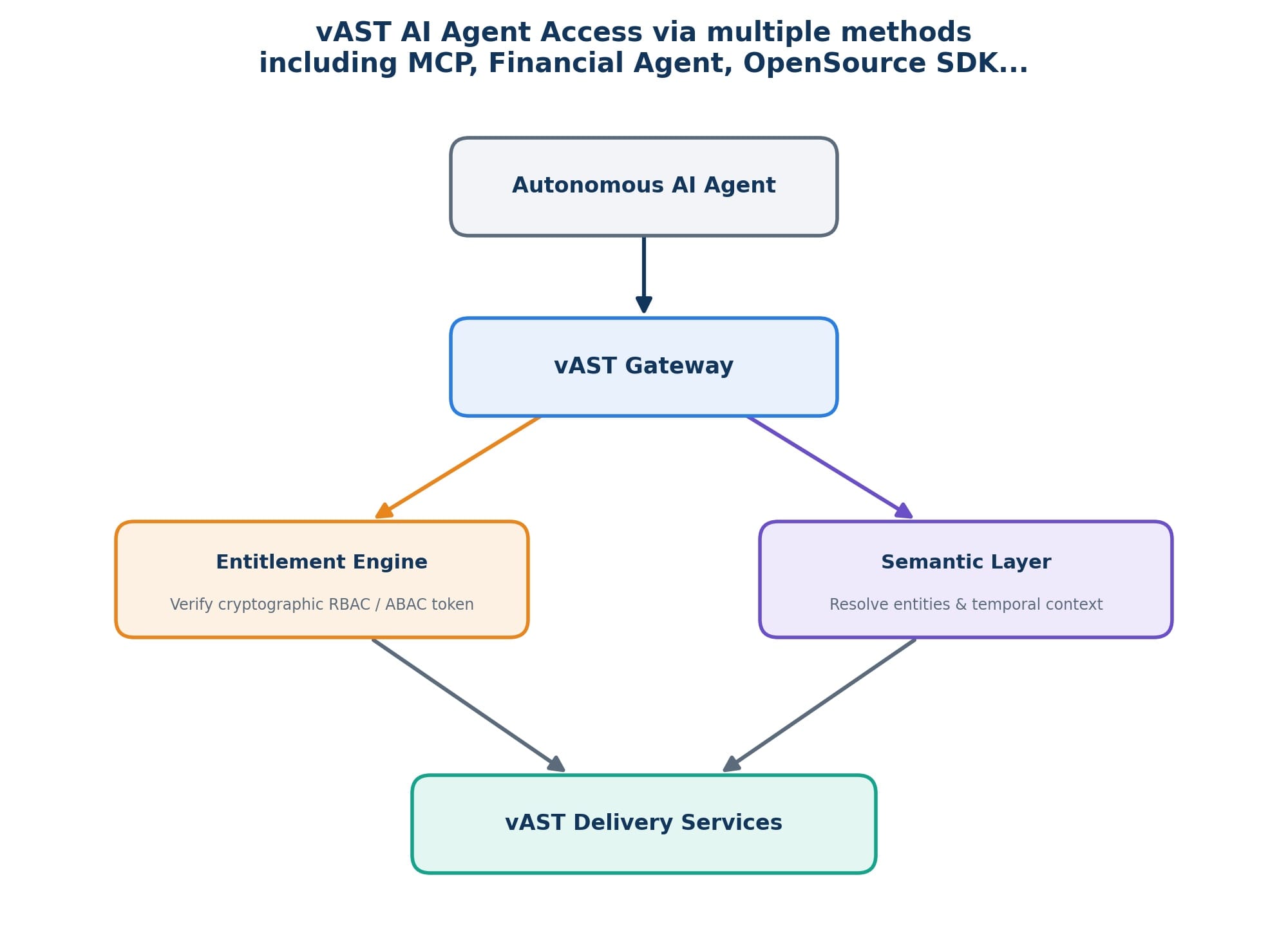
- Server-Side Entitlement Checks: Every MCP tool call undergoes fine-grained role- and attribute-based access control (RBAC/ABAC) verification. The platform confirms that the agent's token is authorized to access specific asset classes, venues, or analytical products.
- Agent-Scoped Credentials: Access permissions are assigned to specific agent identity tokens, enabling audit logging for automated decisions.
Complex Event Processing (CEP) Alerting
To reduce unnecessary API requests, vAST replaces continuous polling with push-based Complex Event Processing (CEP) alerts. Agents can register real-time event triggers directly with the stream processor, such as:
- "Notify when the 5-minute VWAP for deviates more than 2.5 standard deviations from its 30-day moving average."
- "Trigger an execution alert if total consolidated bid-side liquidity drops below $5M across all European venues."
When trigger conditions are met, vAST delivers a structured payload containing the relevant market context directly to the sleeping agent, initiating execution only when necessary.
Conclusion & Production Impact
The viaNexus architecture redefines market data processing by combining low-latency event streaming, graph-based semantic management, and lakehouse storage into a single unified platform. By unifying raw exchange feeds with historical analytics through the Record API and semantic Knowledge Graph, viaNexus eliminates data silos and temporal symbology ambiguities.
This architecture is proven in production environments powering high-scale commercial financial networks, including platforms like SIX Group's Market Signal. In these deployments, viaNexus transforms raw data streams into structured, semantically enriched data products—providing real-time market insight for quantitative applications, institutional trading platforms, and enterprise AI agents.
Ways to Work With viaNexus
viaNexus supports two ways of working with the platform. The first is the viaNexus Marketplace. If you are a data provider, join the Marketplace to publish your datasets and reach new audiences, including AI agents, with entitlements, metering and billing handled for you. If you are a data consumer, use the Marketplace to discover, trial and integrate licensed market data through streaming, RESTful and agentic interfaces.
The second is for large publishers and consumers of market data, such as exchanges, data vendors and institutional firms, who want this capability inside their own business. Talk to us about a white-label or deployed version of viaNexus, running in your environment or under your brand, so you can put the Streamhouse, Knowledge Graph and vAST technology we have already built to work on your use case instead of building it from scratch. Learn more here: https://vianexus.com/direct/
Kick the Tires
Start a free 14 day trial, , add the viaNexus connector in Cursor or Claude, and ask it for more information. Want a deeper look at the architecture, or to discuss a white-label or deployed version? Contact us.
Want more detailed information on the architecture behind viaNexus? Contact us.
Start a free trial, add the connector in Cursor or Claude, and ask it for more information.